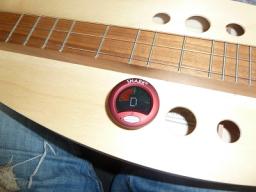
Don't throw your broken Snark away! The head itself will pick up the string vibrations. So just lay it across a sound hole and tune - it is way easier to see than when one is clipped to the headstock.
Very true Jan. For those of us who like to sing in Bb and F (not uncommon at all) then banjo, mandolin and dulcimer do present a few 'challenges' 
Cynthia, love this new instrument of yours! Thanks for showing it to us and playing and singing, too! And, yes, if I ever got up to your neck of the woods (I'm currently in AZ), I'd watch out for the chainsaw in the doorway!
Robin--and not just what sounds best, but you can also consider what fits your vocal range!
Hi Nancy,
The 6+ fret sort of gets in the way of displaying the true difference between the 2 tunings of DAC and DAG. DAC is the Aeolian scale (play the 6th fret not the 6+ as this will give the Dorian scale) and DAG is the Dorian scale (again use the 6th fret not the 6+ as this will give the Mixolidian scale). It is all far more obvious to see the difference on a dulcimer without any extra frets.
Regarding the better tone you are hearing in DAG: Every dulcimer and set-up is different in this respect. We do tend to be a little stuck in our ways by always tuning to the key of D and DAd in general, whereas tuning to a key a little higher to say D#, E of F (careful not to break strings) or a little lower to C or B can bring out a different voice from your instrument. Also, as you have found, using different modal tunings can bring out different voices from our little box of delights! If you are not playing with other folks then it doesn't matter what pitch you are tuned to, so you can play around and find out what sounds best on your particular instrument.
Robin
Marg asked, "If I am playing with a group, do I need to be tune in DAd or can I be in any of the keys as long as I am playing the same DAd tab?"
I know you asked this question at the end of a long day...if you thought about it, you'd realize that if they're playing a song that starts on D, then you'd better be on a D, too, or it will sound pretty bad. You mentioned wanting to practice songs with changing the tunings to hear the difference in the sounds (and it would be "like a new song" every time)...well just imagine that your friend was practicing with you...but they never changed their tuning when you did. Even though the 2 of you might be sharing the same sheet of tab and playing the same numbers, your notes won't be the same and it will "clash".
Some players who don't often play with others just tune their instrument to accommodate the range of their singing voice (which might mean getting strings that are heavier or lighter....it all depends on what works with your instrument). But as long as they are in a "1-5-8" tuning, with the 2 outer strings being an octave apart and the middle string up a "fifth" (the distance from the first "Twinkle" to the second "Twinkle" in the "...Little Star" song), then they can use the numbers on a sheet of music tabbed out for DAd and it will work just fine. They just need to get back in tune with everyone else if they end up in a group situation. Most folks are tuned DAd in dulcimer jams that I've been in, and in a class situation the instructor will tell everyone what tuning to be in...sometimes it stays the same for the whole class and sometimes it changes depending on what the song is. It's usually on the music, too--so you're not just left in the dark to wonder what everyone's doing!
I put three feet (They're small dowel caps from Hobby Lobby) on the backs of my dulcimers, then I put three fittings on the possum board with sockets in them that match up to the feet on the dulcimer.This allows me a positive hardwood-to-hardwood contact between the instrument and board with no actual contact to the instrument back. Also, with the feet sitting in sockets, the instrument does not slide around on the board.
The downside to this approach is that, since my dulcimers are different shapes and sizes, each has to have its own board. I make my own boards in a backyard workshop, though, so they're cheap.
I have tried a bunch of stuff, from typical teardrops and rounded triangles brought over from my guitar, elongated teardrops from my mandolin, thumbpicks from my banjo, V-picks, and I still have an original first-generation tri-gauge Herdim (when they were white). I've even cut them from credit cards. Ultimately I came back to the classic 355-style (large triangle) celluloid picks from Fender and D'Andrea that almost every dulcimer maker at one time threw in with instrument purchases.
I buy 355s in medium and heavy gauges, usually in bulk. Some of these I cut in half to produce elongated picks that are great for flatpicking, as well as brushing strum styles (a little reminiscent of the sound of quill plectrums); the uncut full picks produce volume. I have recently begun gluing grip tape (usually used for tennis and raquetball raquet handles) to contact points on both sides. With that, I can keep control of the picks with a fairly relaxed grip. I've tried matte delrin picks and nylon picks with molded texturing, but the grip tape works better with less effort on my part.
I play mostly in DAA or another 155 tuning, adjusting pitch now and then to sing something. I like having those notes below the scale on the melody string, and I like the way it chords. If you really enjoy chording, it's also great for minor key songs without having to retune.
Occasional adventures outside include DAd, DAG, DAc, and Aaa. I also enjoy creating a modal minor scale using a capo on the first fret in DAA.
In DAG tuning, the scale starts on the 4th fret; in DAc it starts on the 1st fret. It's like the relationship of DAA and DAd.
If you're looking for a B-flat, there's one in DAc (6th fret); but there's not one in DAG, unless your dulcimer has a 1+ or 8+ fret.
ken,
This is great news for me. As exciting as it was today playing in CGc, I can't wait to try each of the tunings and see how they sound.
One more question, if you don't mind - if I can play DAd in all the (Mixolydian Modal Tunings)
If I am playing with a group, do I need to be tune in DAd or can I be in any of the keys as long as I am playing the same DAd tab?
Thanks so much ken, I think my days just aren't long enough to do this all in short order. I think, as I am playing with the different tunings I should make notes on which songs sound better with which tuning.
Since I need to pratice the songs I have anyway - to be able to do it now with the different tunings will be like a different song each time.
The more I learn, the more it all gets better :-)
You can play DAd tab using ANY of the Mixolydian Modal Tunings:
AEa, BFb, CGc, DAd, EBe, FCf, GDg
But not all from the same set of strings!
Likewise you can play DAA tab using any of the Ionian Modal Tunings:
AEE, BFF, CGG, DAA, EBB, FCC, GDD
The same holds true for other Modal tunings as well as Bagpipe and some others. You use the same tab and fingers by the by changing the tuning you play in a different. Keynote.
My dulciborn I had tuned DAd. I retuned it to CGc after I tead I can play DAd tab. The cords have different names but the tab is the same. I played all afternoon, so many of the songs I had been playing in DAd I could now play in CGc and many sounded really nice.
Members that are tuned in CGc, have you played the DAd tabs with the CGc tunning? Anyone in DAd, if you haven't tried CGc yet, do. You wont be changing your fingering but playing everything the same except one key lower - From D to C and A to G
I feel like I made a discovery today, I went back and read the post in this discussion and didn't see anyone had mention CGc can be played with DAd tab. I hope I'm not wrong because it sounded gran.
I've been working on a tune Parting Glass and found I like the minor tuning. A time ago I tuned to DAc and today I found a song in Dminor tuned to DAg. Both tunes show a Bb, so now I'm curious about the difference. I retuning to the DAg, I really like how that sounds compared to DAc.
Thought I'd post to Theroy group, but I didn't see a good place for this question. If it needs to be ther that is find by me.
Thanks,
Nancy G.
Archie -- better to use a calculator, like the one at http://www.strothers.com/string_choice.htm so you KNOW what string you need rather than what someone simply tells you you need. Sometimes good intentions don't work out too well.
Thanks so much John, Sheryl and Lexie. John - I think it's more being able to actually play the guitar, and get a key that works for my voice. The mansion, ROFL, I'll have to put a sign at the end of the driveway. ...just don't trip over the chainsaw coming in the door!
You can also try a nearby Guitar Center store. They sell strings separately by gauge at the parts counter.
If you don't need the brass "ball" on the end of some strings, you can carefully remove it by squeezing it sideways with large pliers. It will fracture and collapse into 2 or 3 pieces which can then be removed, leaving a plain loop at the end.
Archie, if you are just looking for strings, you don't need a dulcimer store. Dulcimer strings are no different than guitar or mandolin or banjo strings. Steel is steel. All you need to know is the gauge of the strings you want and whether you need ball or loop ends. Then you can buy strings from any music store.
And the 26" is probably the vibrating string length, meaning the distance from the nut to the bridge, not the total length of the instrument, so your instrument and the other one are probably about the same size.
Great sounding guitar good tunes and loved your singing along. Very much enjoyed hearing you play.
(Almost everyone today lists tunings from Bass to Melody -- DAA, DAd, GDD, GDg; not the other way around. However, there are still a few older books which list from Melody to Bass, )
Ah, thanks ken. that's it, DDDG should be listed as GDD.
Almost everyone today lists tunings from Bass to Melody -- DAA, DAd, GDD, GDg; not the other way around. However, there are still a few older books which list from Melody to Bass, as well as a few older players who still use that system.
Almost no one lists the tuning of all four strings when they have a doubled-string dulcimer -- unless the couplet is tuned to two different notes. A four string dulcimer with a doubled bass string will often be listed as DdAd for example, but hardly anyone lists DAdd for a doubled melody-string.
Four equidistant string instruments always list all four strings -- dddd for example -- to let you know it is four-equidistant.
I have my student dulcimer tune to DDDG, G on the base. But my red stain one is tuned to DAA, D on the base.
How do we tell which way to read the tuning so we know we have the right one on the right strings? Seems some we read left to right but some we read right to left.
Jan, I've seen that head, too, but it was on Edsel, not Fred. Seems that Edsel based some of his carvings of hillbillies on folks he knew. Now that they're all gone, we probably won't know who they are. I will say on the dulcimer in question the Eagle looks good enough to be Edsel's (not sure about the glass eyes, tho') and the pegs look "right."
Interesting take on music theory, Kevin--different from what we usually read on this site. It reminds me of a story a hammered dulcimer teacher tells of a music theory class he was taking where he was the only student who understood all the modes and how they worked. He said the reason he understood it was because he played the hammered dulcimer and all the modes are laid out there in plain view, so it's easy-peasy. (well, I don't think he said that last part!) So you have an understanding of one part of music theory because of a particular instrument you played. My piano teachers were always writing the circle of fifths on the front covers of my books...and even though I have a basic understanding of it as a dulcimer player, I still don't know why it was an important thing for me to learn on the piano (but I'm sure someone here will explain that to me!) By the way, when I was in elementary school, happily playing the piano by ear (long before lessons started in high school) I first played mainly on the black keys; I played in the key of F#. After a couple years, I suddenly switched to Ab--I have no idea why. I only played in the key of Ab for several years. Peculiar, I know. I'm picking up music theory in small, easy to digest chunks, for the most part. I took a Coursera class from Berkley School of Music that was good and I had Josh Goforth at Swannanoa for a week of music theory and that was great--he's amazing! Things are starting to click, bit by bit.
Yep - following DAd TAB would work every time in DDG for the melody (not chords) on the melody and middle drone string. You are playing in the key of G from the open melody string as 'do' against 5th drones.
Regarding how many tunings there are for dulcimer - the answer is both complex and simple (or is that the other way around?) There are hundreds of tunings if you count every variant repeated at every pitch and every inversion of that variant. You could drive your self mad trying to count them all. However, tuning the dulcimer actually follows some very simple rules. Here are the rules for noter drone playing:
Rule 1 - Where is the root note on my fretboard for the tune I want to play (the mode)?
Rule 2 - Is that root note at the pitch (key) that I want? - if not, then I need to retune the melody string.
Rule 3 - Do the drones blend with the melody string's root note of my tune in the timbre I want? - if not, then I neet to retune the drones to the root note and/or the 5th note of the melody string's scale that I'm going to play.
Every noter drone tuning configuration follows these 3 rules.
You could do something very similar to produce rules regarding chord melody tunings.
I should also say Jan, I think all the designs of the 'circle of fifths' are very interesting. They go back so far, a good history lesson. One of the paintings I just finished for a St. Jude donation was a circle design, would be interesting to place a bit of music theory within the piece.
With my brother and I's "Instrument acquisition and play wars" that one was easy for me (sort of?). The big 120 bass accordion for me taught me just that as the 120 buttons opposing the keyboard are arranged in the circle of fifths. Only one button is marked for identification and is usually the root bass for the key of C or a bass C note is sounded when that button is pushed. All of the chords are aligned diagonally and in the keys of the circle of fifths. From the middle C, C chord row, going up took you through the sharp keys and going down took you through the flat keys. That alone is when I discovered that there was indeed a key of G#, which of course sounds identical to the key of Ab. Written differently, yet the very same exact notes and chords. The ones that make you scratch your head are keys such as Cb or the key of B#. Legit in every fashion on paper and notation, but nonexistant when it comes to actual music that is played. Fun stuff (at least for a music nerd like me?) Kevin.
;-)
Wouldn't take much to tie my brain up in knots. I think the idea of a 'circle of anything' would have me going in circles and never getting anywhere but thanks for the thought of a merry-go-round ride. I don't even know how many sharps or flats make up what keys or modes, so it wouldn't be much of a ride. I wouldn't even get to start going in a circle other than I have seen the illustration of the 'circle of fifths'.
Everyday I am learning something new but I am still just a happy infant crawling alone with my dulcimer.
Now, Marg, if you want to get your brain REALLY tied up in knots, I suggest you study and memorize the circle of fifths, cycle of fourths, and Star of Modes!
 .
.
Hmm....I never thought about those being "Egyptian heads" (plus I'd been told the other story by a reliable source). I could swear I've seen some with the hair parted down the middle and drawn into a knot at the nape of the neck. Maybe that's something I dreamed....(a "nightmare", Patty would say!!! lol)
Kristi said, "Whoops, guess I should have mentioned treatment presupposes a cased dulcimer. "
I was thinking "cased", too. I would wrap the instrument in cloth and then fill in packing materials in all the empty spaces. Close the case. Then I would wrap the case in bubblewrap because I've never had a problem with it, if it's not right next to the wood inside the case. Now comes the more difficult decisions. How valuable is this instrument? Is it irreplaceable? How far is it traveling? Who's shipping it? If you followed the advice to put it in a "corregated cardboard cement form tube" then you'd just shove it in there, fill in the spaces, fill in both end, tape, and you're pretty much done. But I've never done it that way, so my experiences is only with cardboard boxes.
You will pay a whole lot of money to ship UPS, esp. if they pack it. I've personally had experiences where shipping the dulcimer was more than the price I paid for it--that just doesn't make sense!!!! If I have the time to pack it well and send it USPS, then that's what I do. It saves a lot of money, but you do need to pack it well! If you can double box it, that's best. But if you can't, then PLEASE get a VERY STURDY corregated board shipping box, add extra pieces of cardboard front, back, wrap cardboard around the ends of the case, and make sure ALL the spaces are filled. Shake it. Add more.
Just please do NOT use a box that a vacuum cleaner came in from the department store, etc. They have no STRUCTURAL INTEGRITY--"the ability of an item to hold together under a load, including its own weight, resisting breakage or bending.' You have to assume rough treatment by shippers. When you get done packing this instrument, you should at least be confident that IF you stood on it--but don't!!!--then the package would not bend, collapse, etc. If that's too hard to wrap your mind around, then think about it being at the bottom of a stack of boxes--and each of those boxes on top of it are holding a case of copy paper or two....
I once had an irreplaceable instrument sent to me in a practically indestructable instrument case--that I was not able to buy--and then paid to have the case shipped back across the country...and that was the right solution for that item. The case was then packed, as I described above, in a sturdy outer box.
I had someone send me an instrument that was rattling around in a box with a few sheets of newspaper crushed into balls at the bottom of the box. That it survived the trip of 100 miles without even being in a case is, in fact, a miracle.
Hope these tips help. Just don't put yourself in a position where if something goes wrong, you say "I should've".......
Jan.... I thought it said Gertrude Martin on the back of the head and that might have been the owner. My assumption, incorrect it seems, was that it had an Edsel label in it.
No, Jan, Fred told me they're Egyptian heads since the Bible speaks of dulcimers in Eqypt. As far as I know, and remember from seeing all the instruments in his shop, the heads were identical on Fred's.
This was the point I made in a note to the seller: ...so if the dulcimer said Martin with no first name, how could one be sure which brother had made it?
The seller was claiming Edsel had made it, but when I asked why he thought that, he didn't give me a straight answer--and then blocked me from bidding on it. He was saying the carving on the instrument said G erwin Martin, Swannanoa, NC, but said "That's how Edsel signed many of his" and said he got this information "from the web".
What it actually said, however--and I told him this--was "Genuine Martin", not "G erwin Martin". I wasn't questioning that it was made by one of the brothers, I just wanted to know why he was convinced that Edsel had made it.
I really don't think think there's anything out there on the web to support a signature of G erwin Martin, as he is claiming. I think he knew he had a Martin dulcimer and it would sell for the most money if it were touted as being made by Edsel. The outcome is that someone got a fine example of a dulcimer made--maybe--by one of the Martin brothers of Swannanoa, NC....
Oh--and those heads Fred carved on his? My understanding is that they were likenesses of relatives and other women in the community that he personally knew.
No, Fred, died several years ago. After I bought my 1st dulcimer from him, I'd stop at the shop when I was in the area and talk to him for a little while. Nope, never seen nor heard of a "Genuine Martin." I'd think they were the kind of folks who wanted their full name on them.
Rob, do you recall ever hearing that they were signed "Genuine Martin" without the name Edsel, Fred, or Wade?
Is Fred still living? This "Fred told me" comment sounded like a recent conversation....